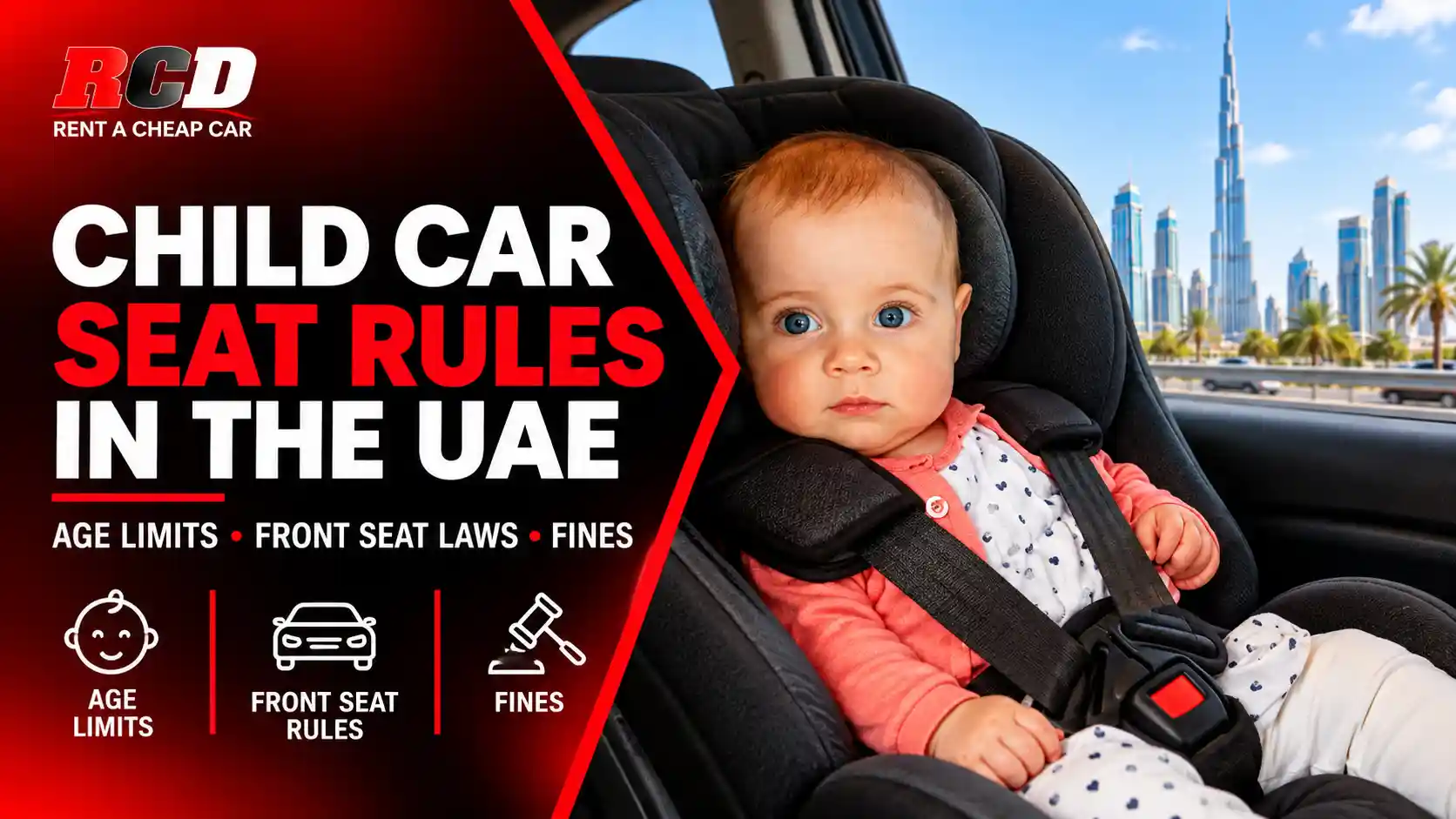
When travelling with children in the UAE, it's not just about picking a comfortable car. There are child car seat safety laws that parents and drivers need to adhere to, not only to keep kids safe but also to avoid fines. Knowing the proper position to sit in, age limits, and child restraint guidelines makes family travel safer, whether driving privately or hiring a car.
What Are the UAE Child Car Seat Rules?
The UAE has specific traffic regulations to protect children travelling in cars. The main legal requirements are:
- Children under 4 must be in a suitable child safety seat.
- Children under 10 years old or shorter than 145 cm are not allowed to sit in the front passenger seat.
- All passengers (including children) are required to wear a seat belt.
- Child safety seats must be suitable for the child's weight and height and installed according to the manufacturer's instructions.
These requirements apply to private cars or rental cars. The driver must make sure that children are appropriately secured before starting the journey.
What is the Age Limit for Sitting in the Front Seat in the UAE?
Dubai Government traffic guidance states that children must be over 10 years old and at least 145 cm tall before sitting in the front passenger seat.
There is a wording difference worth noting: the English text of Article 31 BIS of Ministerial Resolution No. 130 of 1997 uses "over 10 years old or at least 145 cm tall". However, Dubai Government guidance and the published traffic penalty schedule state that children under 10 years old or shorter than 145 cm must not sit in the front seat. To avoid a fine, follow the stricter public guidance: a child should meet both conditions before sitting in front.
For example, a nine-year-old child who is 150 cm tall should not sit in the front seat. Also, if a child is 11 but shorter than 145 cm, they should stay in the back.
The front passenger seat should also be securely belted. Young children should not be placed near active airbags, as they can cause serious injuries.
Age-Based Child Safety Seats Laws
The right seat is determined by your child's age, weight, and height. UAE law specifically calls for child seats for children under 4 years of age.
|
Child's age |
Recommended car seat |
|
Below 1 year |
Rear-facing infant car seat (for children under 10 kg, positioned in the middle of the rear seat) |
|
1–4 years |
Rear-facing or forward-facing seat with harness, according to the manufacturer's limits |
|
4–6 years |
Forward-facing child seat with a suitable harness |
|
6–11 years |
Suitable booster seat, up to 36 kg, depending on height and weight |
|
12 years and above |
Adult seat belt when it fits correctly |
The Dubai RTA Driving Safely Handbook offers age recommendations for child restraints. Its recommended age groups overlap, so never use age alone to choose a seat. Always consider your child's height and weight and follow the seat manufacturer's guidelines.
What is the Fine for a Child Without a Car Seat in the UAE?
A child without a car seat travelling with you can result in a fine. AED 400 may be imposed for driving with a child under four years old without a suitable child safety seat.
The fine is applicable if the driver doesn't provide the necessary child restraint. Remember: Even if you're carrying a baby in your arms or carrying a baby on your lap, this doesn't mean the baby is properly secured in a car seat.
There are also penalties for other child-related traffic violations:
|
Traffic violation |
Fine |
Black points |
|
Child under 4 without a safety seat |
AED 400 |
- |
|
Child under 10 or shorter than 145 cm in the front seat |
AED 400 |
- |
|
Driver not wearing a seat belt |
AED 400 |
4 |
|
Passenger not wearing a seat belt |
AED 400 |
- |
A driver who fails to wear a seat belt will also incur four black points. The published Dubai traffic penalty schedule does not list black points for passengers who fail to wear a seat belt.
Why Car Seats for Kids are Essential?
A standard car seat belt is designed for use by an adult's body. It may not fit the shoulders, chest, and hips of a small child properly.
An appropriately installed child seat helps distribute crash forces and reduces the risk of serious injuries in case of sudden braking or a collision. An infant's head, neck, and spine are supported in rear-facing seats.
Parents should always:
- Follow the manufacturer's directions when installing the seat.
- Ensure the harness is properly fitted and fastened.
- Do not install a rear-facing infant seat in front of an active airbag.
- Don't carry children on their laps.
- Never leave your child alone in a parked car.
Child Car Seat Rules When Renting a Car in Dubai
Parents travelling to Dubai should enquire about the availability of child seats in their rental car. Child safety regulations apply to rental cars, just as they do to privately owned vehicles.
For those with multiple kids, try to rent an SUV or 7-seater for more passengers and luggage. Additional seats do not exempt you from the need for proper child restraints, though.
Before picking up the rental car, check:
- The availability of an infant, toddler or booster seat.
- Whether the seat is appropriate for your child's age, height and weight.
- Whether installation assistance is provided.
- Whether the child seat rental will be charged or not.
By securing the right seat in advance, you can avoid any delays and start your journey safely.
Common Errors Parents Should Avoid
Even though parents know about UAE child passenger safety, some common misconceptions can endanger children.
- Avoid sitting a child in an adult seat belt without checking for proper fit.
- When the child has grown out of the limits of the infant seat, replace it with an appropriate seat.
- Improperly fitting a car seat or leaving it unsecured.
- Giving children the option to stand or move around between seats while driving.
- Assuming that children do not need to be secured in a child seat on short journeys.
These measures are designed to keep young passengers safe in their daily travel, school runs, and as part of a family road trip.
Upcoming Child Car Seat Regulation Changes in the UAE (2027)
The UAE has announced new traffic regulations under Cabinet Decision No. 174 of 2026, which will take effect on 1 January 2027.
Under Article 11, child safety seats for children aged four and under must be suitable for the child's weight and height, comply with applicable UAE standards, and be installed in the rear seats.
The regulations also provide exceptions for children whose medical conditions prevent them from using a protective seat, subject to an approved medical certificate and an accompanying attendant. In vehicles without rear seats, a child safety seat may be installed in the front, provided it faces backwards and the airbag is deactivated.
Source: Emirates News Agency (WAM) – New UAE Traffic Regulations
Final Thoughts
Knowing the child seat laws in the UAE will help parents to prevent traffic fines and keep children safe on the road. Always use an age-appropriate restraint and obey front-seat guidelines. Make sure that all passengers are wearing seat belts. Whether renting a family car or driving one's own car, children's safety should be a priority on every trip.
Please refer to the Dubai RTA Driving Safely Handbook and UAE traffic fines and regulations for further guidance. You can also consult the official UAE traffic legislation.
FAQs
Emila Hales
My name is Emila Hales. I've been living in the UAE for the past five years, and I absolutely love traveling. Writing about my travel experiences is something I enjoy, and I'm excited to share my adventures with others who are passionate about exploring new places.
Learn More