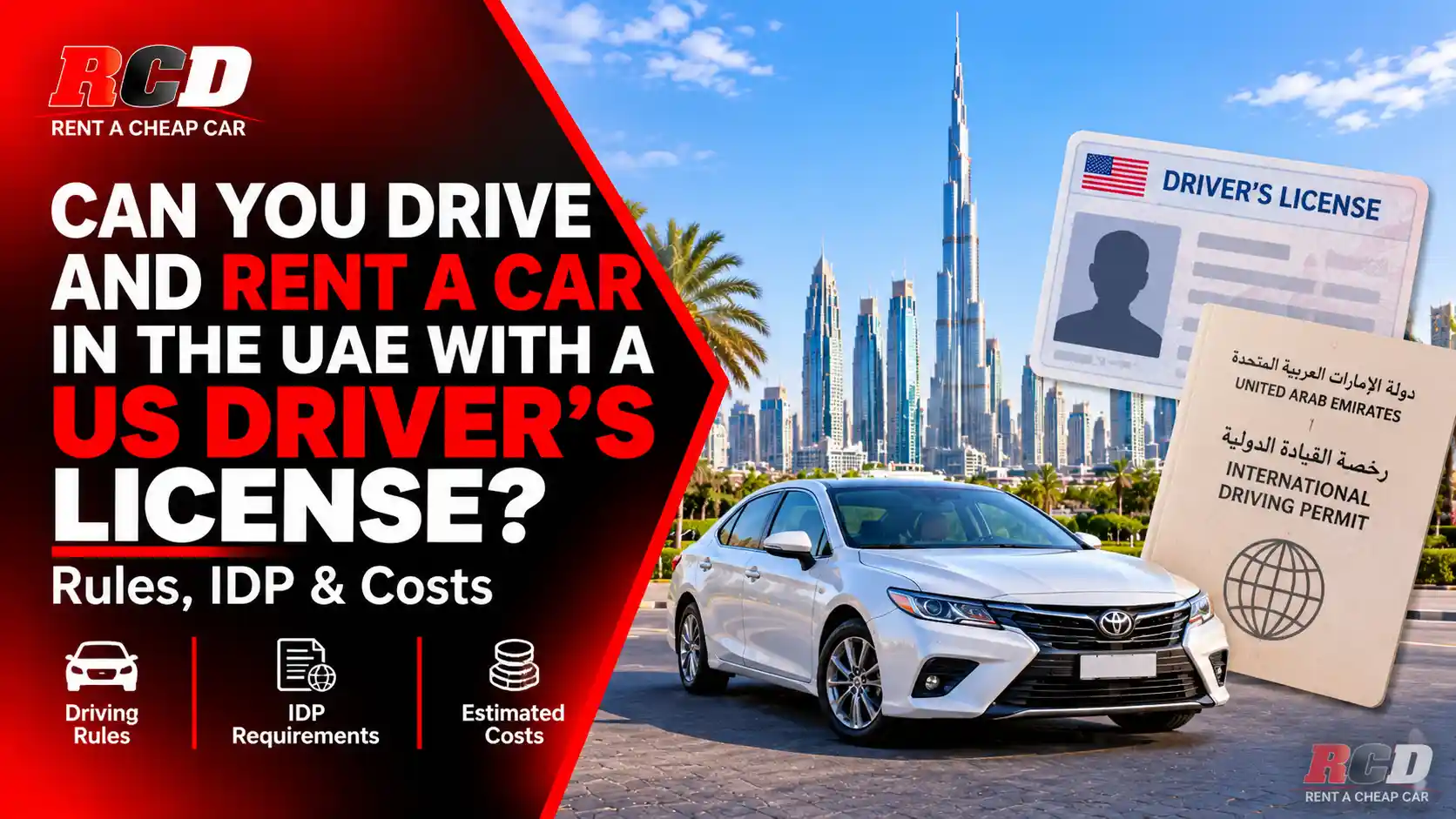
Yes, American tourists can legally drive and rent a car in Dubai and across the United Arab Emirates using a valid US driver's license, without needing an International Driving Permit (IDP). However, your exact eligibility depends on your visa status, passport nationality, minimum age, and the rental agency's policies.
Below is everything you need to know about driving requirements, documentation, RTA license conversion, and rental costs before getting behind the wheel.
Can I Drive in Dubai with a US License as a Tourist?
Yes. US citizens visiting on a tourist or visit visa can drive legally throughout Dubai and all seven emirates using their original US driver's license, no IDP required. The UAE Ministry of Interior (MOI) Markhoos initiative officially recognizes valid United States driver's licenses for short-term visitors.
US passport holders receive a free 30-day visit visa on arrival, which makes it simple to rent a car in Dubai as soon as you land.
Before driving, confirm that you meet these four requirements:
- Valid physical license: You carry your original, unexpired plastic US driver's license (digital IDs, phone photos, temporary paper permits, and learner's permits are not accepted).
- Active visitor status: You hold a valid UAE entry stamp or tourist/visit visa.
- Minimum driving history: You meet the rental agency's minimum license-holding period (typically 12 months).
- Age eligibility: You meet the minimum age requirement for the vehicle category you want to book.
Important exception for non-US citizens: Direct recognition under the Markhoos framework applies specifically to US passport holders carrying a US license. If you hold a valid US driver's license (for example, as a US resident or student) but travel to the UAE on a passport from a non-exempt country, carry an International Driving Permit alongside your US license to avoid rental rejections or police penalties.
Is It Possible to Hire a Car in Dubai with a US Driving License?
Yes. Most licensed rental providers in Dubai, including RCD Rent a Car, accept a valid US driver's license from eligible tourists without asking for an IDP. Whether you book an economy hatchback, a family SUV, or a luxury convertible, the agency will verify your identity and license details before handing over the keys.
Documents Required to Rent a Car in Dubai
US visitors need to present the following original documents at pickup or delivery:
|
Required Document |
Purpose |
|
Original US driver's license |
Confirms driving eligibility (physical plastic card required) |
|
Valid US passport |
Verifies identity (must have at least 6 months of validity) |
|
UAE visit visa or entry stamp |
Confirms legal tourist/visitor status |
|
Credit card (or approved payment method) |
Covers rental payment and security deposit (debit/cash accepted with no-deposit plans) |
|
International Driving Permit (IDP) |
Not required for US citizens; required if traveling on a non-exempt passport |
Some agencies enforce extra conditions depending on the car class, such as requiring at least one year of driving experience on your US license.
Minimum Age for US Drivers
The standard minimum age to rent a car in Dubai is 21 years old, though age thresholds depend on the vehicle class and agency policy.
Drivers aged 21 and older can typically rent economy cars and standard sedans, while high-performance sports cars and luxury models generally require drivers to be 25 or older (and sometimes hold a license for 3 or more years). Always confirm the exact age requirement for your chosen car before booking.
Do US Citizens Need an International Driving Permit (IDP) in Dubai?
No. US citizens visiting the UAE on a tourist visa do not need an International Driving Permit as long as they carry their valid, original US driver's license.
An IDP is an official multilingual translation booklet that accompanies your domestic license, it never replaces your physical card. While not legally mandatory for American tourists, obtaining one can still be a smart precaution if:
- You are traveling on a non-US passport while holding a US driver's license.
- You plan to drive into rural areas outside Dubai and Abu Dhabi where police checkpoints may prefer an Arabic translation.
- Your chosen rental company lists an IDP in its internal insurance terms.
Plan ahead if you want an IDP: You cannot apply for a US-backed IDP after landing in the UAE. It must be issued in the United States before departure through an authorized body such as the American Automobile Association (AAA) or the American Automobile Touring Alliance (AATA).
Can a US Resident Drive in the UAE with an American License?
No. Once your UAE residence visa is issued, you can no longer legally drive using a US driver's license, even if your American license is unexpired and you also hold an IDP.
The tourist driving exemption ends the moment your status changes from visitor to resident. If you are relocating to Dubai for work, business, or long-term living, you must obtain a UAE driver's license before driving. Driving on a foreign license as a UAE resident risks heavy fines and voids your vehicle insurance in the event of an accident.
How to Exchange a US Driver's License for a UAE License Through RTA
Eligible US citizens with a Dubai residence visa can convert their valid US driver's license directly into a UAE license through the Roads and Transport Authority (RTA) without taking driving classes, theory exams, or road tests.
(Note: If your residence visa is issued in Abu Dhabi, apply via the TAMM platform; residents of Sharjah and the Northern Emirates apply through the MOI app or local police licensing centers.)
Documents and Requirements
To complete a direct license exchange in Dubai, prepare the following:
- Original, unexpired US driver's license (plus front-and-back copies).
- Valid Emirates ID and UAE residence visa details.
- Electronic eye test certificate from an RTA-accredited optical center.
- Additional verification documents, if requested by RTA (requirements can vary by issuing state or if your passport nationality differs from your license country).
You can start your application online via the official Dubai RTA Driving License Exchange portal using UAE Pass, or visit an RTA Customer Happiness Centre in person. Once approved, you receive an instant digital license in the RTA Dubai App (My Docs) alongside a printed card via self-service kiosk or courier delivery. For federal licensing rules across all emirates, check the Official UAE Government Driving License Portal.
RTA License Exchange Costs
Expect to pay approximately AED 1,010 to AED 1,050 in total for a standard direct exchange in Dubai:
|
Fee Component |
Estimated Cost |
|
Electronic eye test |
AED 140 – AED 180 |
|
Opening a Traffic File |
AED 200 |
|
Driving license issuance |
AED 600 |
|
Handbook manual |
AED 50 |
|
Knowledge & Innovation fee |
AED 20 |
|
Optional courier delivery |
AED 20 – AED 50 |
Verify current fees on the RTA portal before submitting your application, as government tariffs are subject to updates.
How Much Does It Cost to Rent a Car in Dubai?
Renting a car in Dubai starts around AED 50 per day for economy models and climbs to AED 700+ per day for luxury vehicles, depending on vehicle class, rental duration, and travel season.
|
Vehicle Category |
Estimated Daily Rental |
|
Economy cars |
AED 50 – AED 100 |
|
Compact sedans |
AED 80 – AED 150 |
|
SUVs |
AED 150 – AED 300 |
|
Luxury vehicles |
AED 300 – AED 700+ |
Rates fluctuate based on peak tourist seasons (November–March), model year, mileage allowance, and insurance coverage.
Additional Costs and Insurance Rules to Remember
Your advertised daily rate rarely tells the whole story. Factor in these common rental expenses and local policies:
- Security deposit: Most traditional Dubai agencies place a refundable hold of AED 1,000–3,000 on your credit card for 7 to 21 working days to cover delayed fines or tolls. If you prefer not to tie up your credit limit, RCD Rent a Car also offers flexible no-deposit car rental in Dubai plans with debit card or cash options.
- Insurance & the Police Report rule: Standard third-party/basic insurance is included in UAE rentals, with optional upgrades like Collision Damage Waiver (CDW) to reduce your liability excess. Keep in mind that US domestic auto insurance does not cover you in the UAE. If even a minor scratch or bumper tap occurs, you must obtain an official Dubai Police report (via the Dubai Police app or by calling 999); without it, rental insurance claims will not be honored.
- Salik and Darb tolls: Dubai's electronic Salik toll gates operate on variable toll pricing: AED 6 during peak weekday hours (6 AM–10 AM and 4 PM–8 PM), AED 4 during low-peak hours, and free from 1 AM to 6 AM, plus 5% VAT on toll transactions. Driving into Abu Dhabi triggers Darb peak-hour tolls. Agencies bill tolls automatically after your trip.
- Parking: Paid public parking zones apply across most of Dubai and are easily paid via the RTA Dubai app, SMS, or parking meters.
- Fuel and mileage: Most rentals follow a same-to-same fuel policy and include a daily mileage cap (often 250 km/day).
- Traffic fines: Speeding or parking fines are linked to the vehicle's license plate and billed directly to the renter.
Always compare the total out-the-door cost, including insurance excess, mileage limits, and deposit terms, rather than choosing a company solely for its advertised daily rate.
Which Is Better: Daily, Weekly, or Monthly Car Rental?
The right rental plan comes down to trip length and daily mileage, lo. nger bookings dramatically cut your cost per day.
Daily rental: Best for quick layovers, 1–3 day business visits, or weekend day trips to Abu Dhabi or Hatta.
Weekly rental: Ideal if you are staying 5 to 14 days. Booking a weekly car rental Dubai package at RCD Rent a Car lowers your per-day cost substantially (with economy weekly deals starting from AED 254 and free delivery across Dubai).
Monthly rental: Once your stay passes three weeks, whether for an extended vacation, remote work stint, or relocation, a cheap monthly car rental in Dubai delivers the lowest effective daily rate and built-in maintenance support.
Important Driving Rules for US Visitors in the UAE
Driving in Dubai feels familiar to Americans, vehicles are left-hand drive and traffic moves on the right, but UAE enforcement is far stricter than most US states.
-
Zero-tolerance alcohol policy: Unlike the US 0.08% BAC limit, the UAE enforces a strict 0.00% blood alcohol limit. Never drive after having even one drink.
-
Watch the Dubai vs. Abu Dhabi speed buffer: On most Dubai roads (like Sheikh Zayed Road), fixed speed cameras allow a 20 km/h buffer above the posted sign (though fines are still calculated from the posted limit). Abu Dhabi has zero speed buffer, radars flash at just 1 km/h over the posted sign. Always drive to the posted number.
-
Seatbelts and child seats: Every passenger, front and back, must wear a seatbelt, and children must sit in age-appropriate child restraints.
-
No handheld phones: Using a phone while driving (even at red lights) carries heavy fines and black points unless you use a hands-free mount.
-
Strict camera enforcement: Speed radars, red-light cameras, and smart traffic monitors operate 24/7. Violations trigger instant fines ranging from AED 300 to AED 3,000+, black points, or vehicle impoundment.
-
Roundabouts and lane discipline: Yield to traffic already inside the roundabout, and reserve the far-left highway lane strictly for overtaking.
Final Thoughts
Tourists from the United States can drive and rent cars in Dubai smoothly without an IDP, provided they carry their valid physical US driver's license, passport, and entry stamp. If you move to the UAE on a residence visa, exchange your US license through the RTA before getting back on the road.
Before booking, double-check your age eligibility, insurance coverage, and deposit terms, and when you're ready to hit the road with transparent pricing and free Dubai delivery, explore the fleet at RCD Rent a Car to rent a car in Dubai with zero hassle.
FAQs

Emila Hales
My name is Emila Hales. I've been living in the UAE for the past five years, and I absolutely love traveling. Writing about my travel experiences is something I enjoy, and I'm excited to share my adventures with others who are passionate about exploring new places.
Learn More