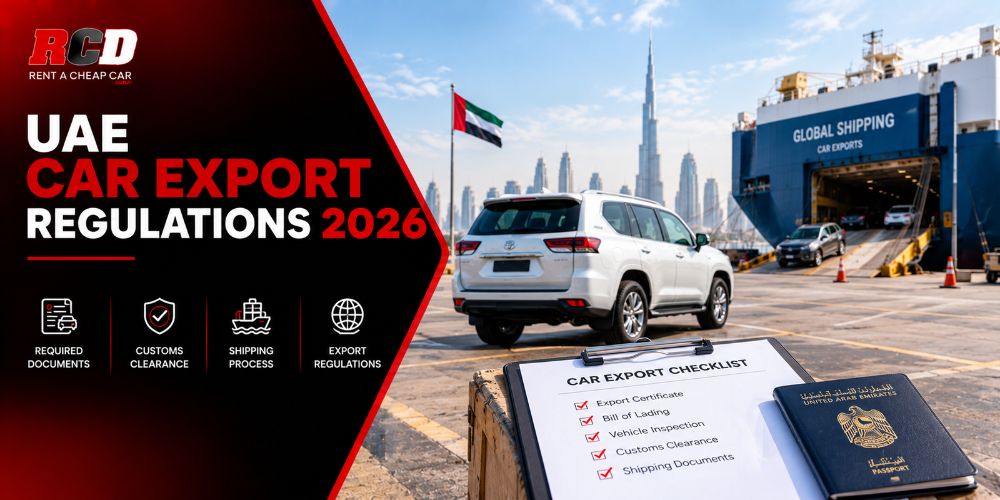
Purchasing a vehicle for export in Dubai may seem like a good opportunity, but when the time comes to send it overseas, the customs agents may reject it. A car that is legal for driving in the UAE may not be legal for driving in other countries. Age restrictions, emission standards, steering position, and missing export documents can make an affordable purchase a costly mistake. For exporting a used Toyota Land Cruiser, a luxury sedan or commercial vehicle, it is essential to know the regulations before making payment.
What are UAE Car Export Rules?
The UAE exports new cars and used cars, following customs formalities, vehicle ownership conditions, and restrictions.
Exporting from the UAE, however, is different from importing it in another country according to legal processes.
The UAE authorities will check the ownership, registration, export documentation, and customs compliance. The age, emissions, safety, and steering requirements of the vehicle are determined by the destination country.
UAE Car Export Age Limit in 2026
The UAE does not have a universal age limit for cars, as it would differ based on the type of car exported.
A car that is eligible for export from Dubai or another emirate could be refused entry to its eventual destination country.
Can You Export a Car Older Than 10 Years?
Potentially, yes. Not all vehicles are banned from being exported from the UAE just because of their age.
For older vehicles, however, maximum age limits, special inspections or other requirements may be imposed by the destination country.
Don't just look at the first registration date when purchasing a vehicle; the manufacturing year is more important.
UAE Vehicle Emission Standard for Export
When exporting petrol, diesel, or hybrid cars, the emission regulations matter.
The UAE uses the vehicle conformity standards for the domestic registration of the vehicle, and importing countries have their own environmental standards.
a. Are Euro 4, Euro 5 or Euro 6 Standards Required?
The UAE does not have a standard that mandates all vehicles in the country to be Euro 6 compliant when exported.
Rather, the appropriate standard will vary based on the country of destination, vehicle type, year of manufacture, and import laws. Before shipping, verify the manufacturer's emission certification, engine specifications, and any required conformity documents.
b. Can You Export a Car Without a Catalytic Converter?
A car without a catalytic converter, or if it is damaged, could be unable to meet emissions standards in the other country.
Changes in the exhaust system, removal of a diesel particulate filter, and changes to the engine-control system software can also cause compliance issues.
It's better to fix them before you export to reduce the risk of rejection.
Left-Hand Drive vs Right-Hand Drive Export Rules

Road vehicles are mostly left-hand drive (LHD) in the UAE. But not all places allow a vehicle with a left-steering wheel.
Dubai's RTA states that a right-hand drive vehicle cannot be registered in Dubai unless it is for classic registration. This applies to exporting right-hand-drive vehicles, but not everywhere. This is a UAE registration rule and not a universal ban on exporting right-hand drive vehicles.
a. Can You Export a Left-Hand Drive Car?
Yes, as per the requirements of the destination country. For markets with right-side road traffic, LHD vehicles are often suitable.
Left-side road traffic countries may only allow a few LHD cars or require special approvals.
b. Can You Export a Right-Hand Drive car from Dubai?
Potentially, yes. Vehicle documentation, customs status, and applicable rules determine eligibility for export.
A vehicle that cannot be registered as an ordinary vehicle in Dubai can be registered in a right-hand drive manner by following an appropriate export/ re-export procedure if the vehicle is being exported from Dubai.
Find out exactly what customs and the shipping agent require.
UAE Car Exporting Rules by Destination
The following table identifies some of the key points to note for key export markets.
Purchasing a vehicle for export in Dubai may seem like a good opportunity, but when the time comes to send it overseas, the customs agents may reject it. A car that is legal for driving in the UAE may not be legal for driving in other countries. Age restrictions, emission standards, steering position, and missing export documents can make an affordable purchase a costly mistake. For exporting a used Toyota Land Cruiser, a luxury sedan or commercial vehicle, it is essential to know the regulations before making payment.
UAE Car Export Rules:
The UAE exports new cars and used cars, following customs formalities, vehicle ownership conditions, and restrictions.
Exporting from the UAE, however, is different from importing it in another country according to legal processes.
The UAE authorities will check the ownership, registration, export documentation, and customs compliance. The age, emissions, safety, and steering requirements of the vehicle are determined by the destination country.
UAE Car Export Age Limit in 2026
The UAE does not have a universal age limit for cars, as it would differ based on the type of car exported.
A car that is eligible for export from Dubai or another emirate could be refused entry to its eventual destination country.
Can You Export a Car Older Than 10 Years?
Potentially, yes. Not all vehicles are banned from being exported from the UAE just because of their age.
For older vehicles, however, maximum age limits, special inspections or other requirements may be imposed by the destination country.
Don't just look at the first registration date when purchasing a vehicle; the manufacturing year is more important.
UAE Vehicle Emission Standard for Export!

When exporting petrol, diesel, or hybrid cars, the emission regulations matter.
The UAE uses the vehicle conformity standards for the domestic registration of the vehicle, and importing countries have their own environmental standards.
a. Are Euro 4, Euro 5 or Euro 6 Standards Required?
The UAE does not have a standard that mandates all vehicles in the country to be Euro 6 compliant when exported.
Rather, the appropriate standard will vary based on the country of destination, vehicle type, year of manufacture, and import laws. Before shipping, verify the manufacturer's emission certification, engine specifications, and any required conformity documents.
b. Can You Export a Car Without a Catalytic Converter?
A car without a catalytic converter, or if it is damaged, could be unable to meet emissions standards in the other country.
Changes in the exhaust system, removal of a diesel particulate filter, and changes to the engine-control system software can also cause compliance issues.
It's better to fix them before you export to reduce the risk of rejection.
UAE Car Exporting Rules by Destination
The following table identifies some of the key points to note for key export markets.
|
Destination |
Vehicle age considerations |
Steering and compliance |
|
Saudi Arabia |
Generally restrictive for older ordinary light vehicles; exceptions and approvals may apply |
Confirm SASO conformity and Saudi import eligibility |
|
Oman |
Age and technical requirements depend on vehicle category |
Verify registration eligibility with Omani authorities |
|
Pakistan |
Different age and eligibility rules for permitted import schemes and vehicle types |
Right-hand-drive registration requirements are important |
|
India |
Strict used-vehicle import conditions |
Right-hand drive and applicable technical standards |
|
Kenya |
Commonly applies an eight-year age restriction for used vehicles |
Right-hand drive and inspection requirements |
|
United Kingdom |
No single universal age ceiling |
LHD imports possible, subject to approval and registration requirements |
Important: Dubai RTA clearly specifies the need to obtain approval to export light vehicles more than 5 years old to Saudi Arabia. The exact age and exemptions, and eligibility required for other countries should be verified with the customs or vehicle registration department before buying.
Documents Required to Export a Car from the UAE!
Even if all technical requirements for a vehicle are met, missing documentation can slow down a shipment.
|
Document |
Purpose |
|
Vehicle export certificate |
Confirms the vehicle's export status and cancellation of registration |
|
Emirates ID or passport |
Establishes the identity of the owner or exporter |
|
Vehicle registration card (Mulkiya) |
Provides registered ownership and vehicle details |
|
Sale invoice or purchase agreement |
Establishes the transaction and declared vehicle value |
|
Customs export declaration |
Records the vehicle's departure through customs |
|
Bill of lading |
Confirms shipment details for sea freight |
|
Certificate of origin |
May be required for customs or destination-country clearance |
|
Bank clearance or mortgage release |
Resolves finance-related restrictions where applicable |
|
Import permit or conformity approval |
Required when imposed by the destination country |
The documents that are prepared by Dubai Customs include certificates of origin, packing list, invoice, and restriction-related permits. Different documentation is required for different transactions.
How to Export a Car From Dubai: Simple Steps!
The following are the steps to export a car from Dubai:
Step 1: Check Ownership and Vehicle History
- Review any outstanding finance, accident history, registration, and chassis number (VIN).
- Make sure that the seller can transfer or export the vehicle.
Step 2: Verification of Eligibility of the Destination Country
- Check the manufacturing year, steering position, emission classification and import permissions.
- Do this step before purchasing anything that isn't refundable.
Step 3: Remove Fines and Financial Restrictions
- Pay off any outstanding traffic fines and make arrangements to settle any vehicle mortgage.
- The vehicle clearance service provided by the RTA can determine if there are any relevant restrictions.
Step 4: Fill out the Export Certificate
- If you are exporting a vehicle out of Dubai, use the RTA vehicle export service.
- Choose the export location and method, obtain identity verification, pay the necessary fees, and hand over the registration plates as directed.
- When the vehicle is exported, its Dubai registration is cancelled.
Step 5: Arrange Customs clearance
Make a customs declaration via Dubai Customs or through an authorised customs clearing agent.
The declaration should accurately identify the vehicle, its value and the intended export.
Step 6: Select a Shipping Method
Common options include:
- RoRo shipping: Applicable for vehicles that meet the criteria.
- Container shipping: Provides enclosed shipment, typically used for luxury or valuable cars.
- Road transportation: Feasible for some countries in the GCC, depending on border and vehicle criteria.
Step 7: Complete Import Clearance
After getting to the destination, the importer is required to settle the customs clearance as well as pay the applicable duties and taxes and pass inspection and registration.
UAE Car Export Fees and Shipping Costs
Government charges, documentation, shipping, insurance, and destination-country taxes are all part of export expenses.
Dubai Customs reports export declaration fees generally ranging between AED15 and AED100; this varies according to the type and channel of export. Additional fees are possible.
RTA certificate and plate fees are based upon the vehicle and export.
Freight charges can differ depending on the size of the vehicle, destination, shipping method, and port handling. Get an itemized quote rather than a fixed advertised quote.
Export Plates and Vehicle Inspection Rules
Dubai may issue export plates when required. These plates are not intended to give the driver full driving privileges.
The condition with regard to vehicles used under export arrangement is that they are only allowed to be operated on routes designated by RTA for exporting purposes, subject to the provisions of the applicable routes.
If the vehicle has a valid license and ownership, there is typically no need for a chassis inspection in the case of an export certificate. Unlicensed or expired ownership vehicles must have a chassis inspection.
VAT and Customs Duty on Cars for Export
Export of vehicles might be subject to zero UAE VAT if the following conditions are met.
We need relevant proof to demonstrate that the car has left the UAE. This may include official customs documentation and commercial shipping documentation.
If the export conditions are not met, it is possible that the standard VAT rate of 5% could apply instead.
The receiving country has import duties, VAT, and registration fees.
Can You Export a Financed or Damaged Car?
Normally, the lender's clearance is required for a financed car before it can be exported. An outstanding mortgage can prevent the export transaction. Restrictions on vehicle destination markets may also apply to damaged, salvage, and/or accident-repaired vehicles.
Verify the importing country’s rules for accepting the condition and title classification of the vehicle.
Final Thoughts
Exporting a vehicle from the UAE is more than just arranging for the vehicle to be transported. The primary verification checks are vehicle age, vehicle emission standards, steering position, ownership clearance, and destination import eligibility.
Verify these conditions prior to car purchase, get the right export papers, and do the proper landed cost calculation. This will help to minimize the chance of vehicle registration denials, unforeseen costs, and delays during customs inspections.
FAQs

Emila Hales
My name is Emila Hales. I've been living in the UAE for the past five years, and I absolutely love traveling. Writing about my travel experiences is something I enjoy, and I'm excited to share my adventures with others who are passionate about exploring new places.
Learn More